
Votre panier est vide
Besoin d'inspiration ?
Rendez-vous dans le programme en ligne du GrandPalais
Article -

At nearly 80 years old, Matisse reinvented himself: he no longer painted, but cut directly into color. With his scissors, he invented a free, direct gesture that gave birth to figures of rare power. A new creative impetus driven by the cut-out gouache technique, whose history and artworks can be discovered at the Grand Palais until July 26 !

In his final years, Matisse allowed himself complete freedom through cut-out gouache. This new medium enabled him to "draw with scissors" and thus cut directly into color, without having to dissociate these two key elements of his expression. Color and form are no longer separate, they become one and the same material to compose.
This new freedom opens up an immense field of possibilities, giving rise to artworks of striking visual power. Gradually, cut-out gouache is no longer limited to vegetal compositions. Matisse uses it to represent monumental figures, such as Zulma and Danseuse créole, which can be seen in the exhibition.
Matisse composed most of his cut-out gouaches on the walls of his apartment. Weakened by illness and old age, he was accompanied by studio assistants. Paule Caen-Martin, Denise Arokas, Annelies Nelck, Jacqueline Duhême: meveral women helped Matisse under the supervision of Lydia Delectorskaya, the artist’s devoted assistant since 1932. They were the ones who covered the large sheets of paper with gouache, later cut out by the artist, or who rearranged, according to his instructions, the cut-out shapes pinned to the wall.
Henri Matisse, Zulma, début 1950
In the studio, everything can happen very quickly. Some artworks take shape in a single day, others in just a few days. Matisse's gesture is precise, but also very free: he adjusts, moves, and layers elements until he finds the right balance. Paule Caen-Martin's account in Matisse, la couleur découpée: une donation révélatrice (2013) sheds light on thecreative process:
"Some works were thrown onto the wall all in a single burst, others took shape slowly. Thus Zulma, now in the Copenhagen museum, was begun one afternoon when Lydia was in Paris, busy with a hanging or some other task. Matisse and I were in the winter room, it was 1950. The master was jovial, relaxed in his wheelchair. He began by cutting out the central blue figure, whose breasts formed an integral part of the shape; then green and yellow leaves had to be slipped behind this form. The large orange flame that runs through it from bottom to top came later, as did the brushstrokes and Indian ink defined the pubis and legs. We stopped there on the first day. Matisse must have studied his work overnight, because as soon as I arrived the next day, he had me plant the table and the purple vase on it, followed by the brown and orange parquet floor. Lastly came the blue and burnt-sienna vase with its bouquet sketched in a single stroke of a grease pencil. We were done in two days. "
- Paule Caen-Martin, Matisse, la couleur découpée: une donation révélatrice, 2013
The medium of cut-out gouache, which is particularly fragile because it is photosensitive, is now rarely exhibited in museum galleries. This is the first time in France, since an exhibition at the arts décoratifs museum in Paris in 1961, that you can discover this essential aspect of Matisse’s artistic practice ! Come and enjoy it at the Grand Palais until July 26.
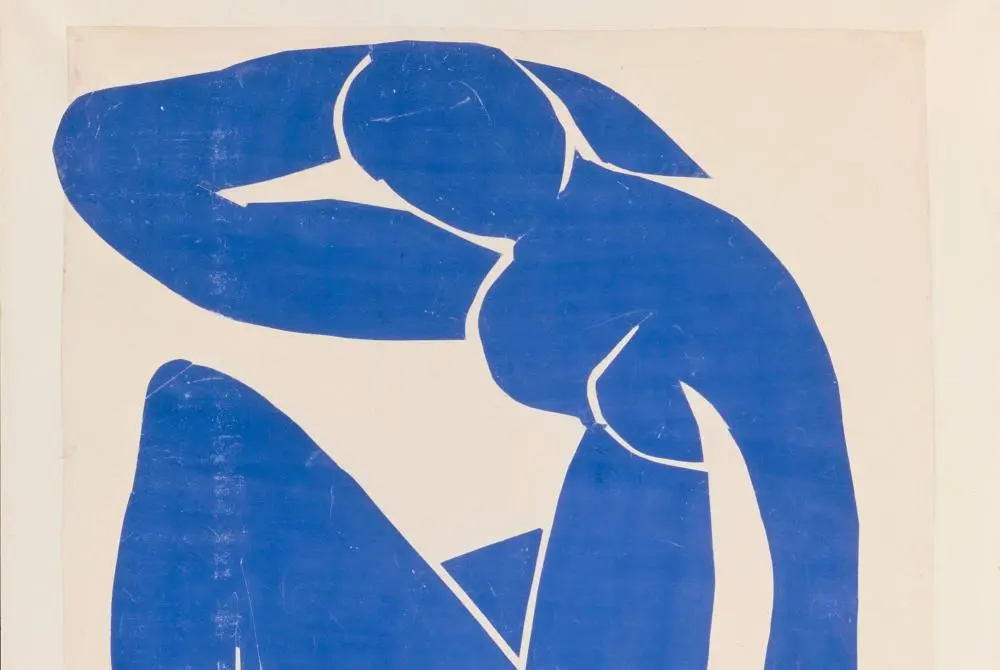
Henri Matisse, Nu bleu II, 1952
Matisse
1941 - 1954
Exhibitions
March 24 - July 26, 2026 - Last tickets available on-site only
Votre panier est vide
Besoin d'inspiration ?
Rendez-vous dans le programme en ligne du GrandPalais

SISTERS, Jim Britt, 1976
Girls
Exhibitions Upcoming
Adolescence, Fashion, Rebellion
December 9, 2026 - March 21, 2027

Mika Ninagawa
with EiM
Alive with Shadows
Exhibitions Upcoming
December 16, 2026 - March 21, 2027

Paul Cezanne, La Montagne Sainte-Victoire au grand pin, vers 1887, huile sur toile, 66.8 x 92.3 cm
Exhibitions
September 23, 2026 - January 17, 2027

Salons & foires Upcoming
October 23 - October 25, 2026

Chroma XXIII (2003-2025) Darmstadt Ferienkurse 2025 Justus Liebig Haus
Rebecca Saunders, Ensemble Intercontemporain
Chroma I–XXIV (2003–26)
Shows & performances Upcoming
Nouvelle version XXIV
November 21, 2026 - Almost sold out
See content : Matisse 1941-1954 : tous les outils indispensables pour une visite éclatante au Grand Palais

Henri Matisse, Acanthes, 1953
Article -
Vous venez découvrir l’exposition Matisse 1941-1954 ? Bonne nouvelle : tout est prévu pour profiter pleinement de la visite, que vous soyez en solo, entre amis, en famille ou avec des enfants. Parcours ludiques, outils accessibles… Suivez le guide pour explorer l’univers vibrant d'Henri Matisse en toute liberté !
See content : Jazz, a major work to be experienced through music in the exhibition "Matisse 1941–1954"

Article -
Between 1941 and 1954, Henri Matisse entered what he called his “second life.” After a serious operation that left him weakened, the artist profoundly reinvented his practice and embarked on one of the most daring chapters of his career. At the heart of...
See content : Nan Goldin, Matisse: ticket sales for our next exhibitions are now open!

Article -
This spring, the Grand Palais invites you to discover two major figures in the art of the 20ᵉ and 21ᵉ centuries through new exhibitions: Nan Goldin. This will not end well and Matisse. 1941 - 1954. Two powerful, sensitive and resolutely different journeys...