
Votre panier est vide
Besoin d'inspiration ?
Rendez-vous dans le programme en ligne du GrandPalais
Article -

Between 1941 and 1954, Henri Matisse entered what he called his “second life.” After a serious operation that left him weakened, the artist profoundly reinvented his practice and embarked on one of the most daring chapters of his career. At the heart of this prolific period, the illustrated album Jazz holds a special place. Featured in the exhibition Matisse 1941–1954 at the Grand Palais, it reveals the invention of a new language based on color, rhythm, and freedom of gesture.
Commissioned in 1943 by the publisher Tériade, the illustrated book Jazz occupies a pivotal place in Matisse’s oeuvre. Conceived as an artist’s book, it gradually became a testing ground for a new technique: cut-out gouache-painted papers. As he worked on it, Matisse discovered a visual language of unprecedented freedom.
Contrary to what its title might suggest, Jazz does not depict the world of music. For Matisse, the word evokes above all improvisation, rhythm, and creative energy. Like a jazz musician, he invents as he goes, allowing vibrant colors and cut-out shapes to interact in a continuous flow.
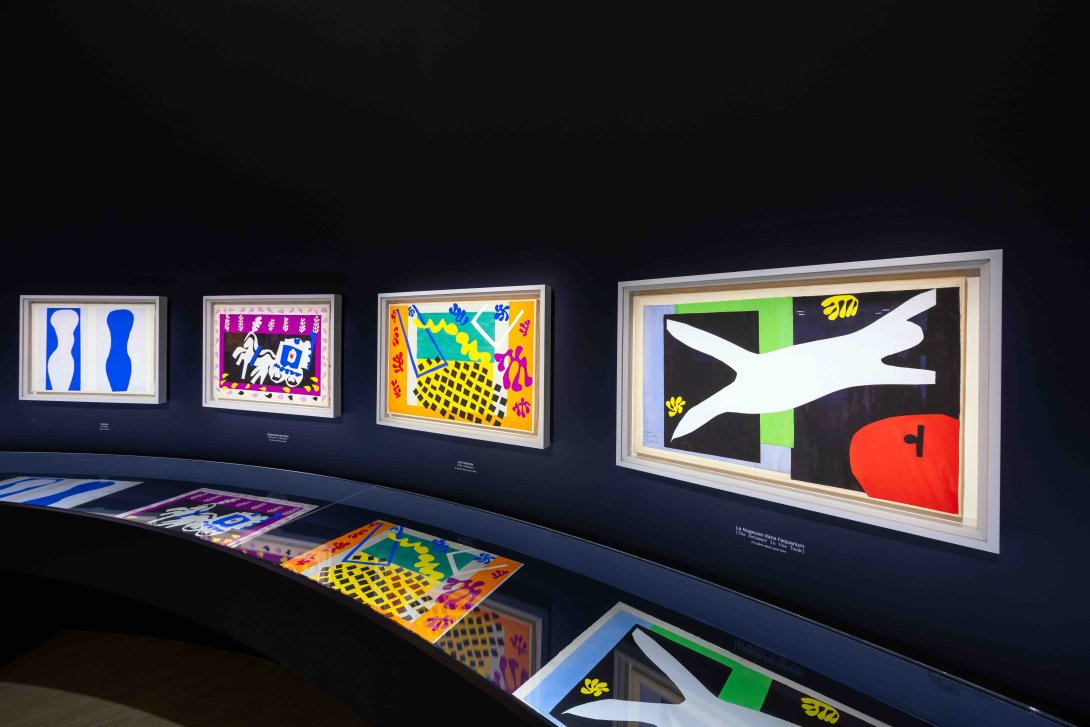
The exhibition brings together, for the first time, the album and its mockup. Presented in a circular space and accompanied by an original electroacoustic composition by Claudia Jane Scroccaro, an artist affiliated with IRCAM, they offer a sensory exploration of this iconic work. Images and sounds interact to convey what Matisse was seeking: a balance between rhythm, color, and movement.
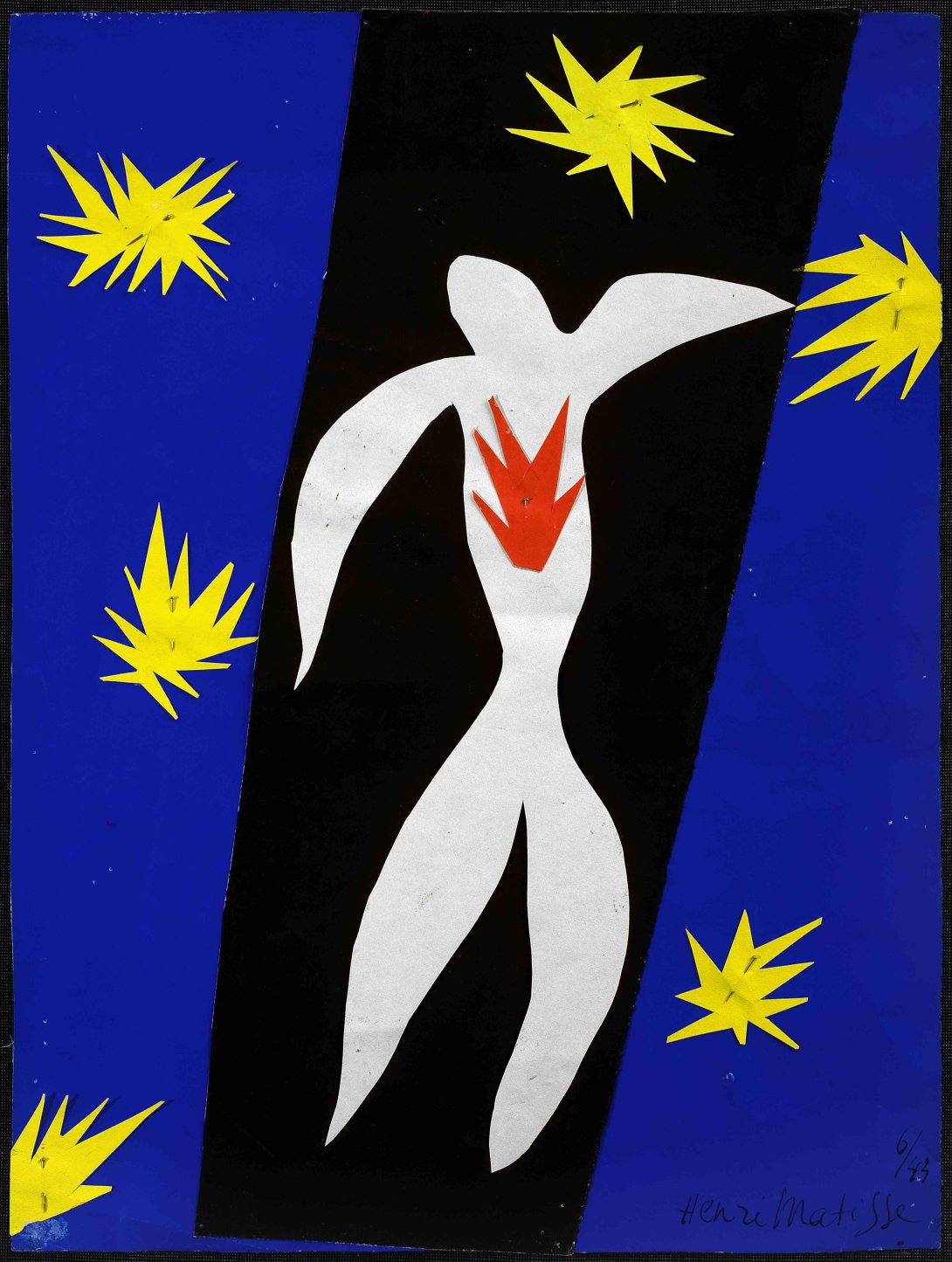
Henri Matisse, La Chute d'Icare, 1943, Papiers gouachés, découpés et épinglés, 36 x 26,5 cm
Among the most famous illustrations by Jazz, “The Fall of Icarus” holds a special place. On display at the Grand Palais thanks to an exceptional loan, this striking composition combines a black silhouette, a vibrant red shape, and a blue background studded with stars. It demonstrates the expressive power that Matisse was able to achieve with just a few cut-out shapes and bold colors, at the very moment he was inventing an entirely new visual language.
Far from being a mere epilogue to Matisse’s career, the cut-out gouaches open up a whole new realm of creativity. In his studio in Nice, colorful shapes gradually take over the walls, shifting, rearranging themselves, and interacting with the space. Through Jazz, as well as the large-scale, monumental cut-outs and the projects created for the Chapel of Vence, the exhibition reveals the full vitality of a period that curator Claudine Grammont sums up in two words: “a moment of grace.”
Jazz is much more than an artist’s book: it is the laboratory in which Matisse invented the language of cut-out gouache papers that would define the final years of his creative career. Go behind the scenes of this legendary work and its exceptional reissue on the occasion of the exhibition on the Centre Pompidou website.
Votre panier est vide
Besoin d'inspiration ?
Rendez-vous dans le programme en ligne du GrandPalais

SISTERS, Jim Britt, 1976
Girls
Exhibitions Upcoming
Adolescence, Fashion, Rebellion
December 9, 2026 - March 21, 2027

Mika Ninagawa
with EiM
Alive with Shadows
Exhibitions Upcoming
December 16, 2026 - March 21, 2027

Paul Cezanne, La Montagne Sainte-Victoire au grand pin, vers 1887, huile sur toile, 66.8 x 92.3 cm
Exhibitions
September 23, 2026 - January 17, 2027

Salons & foires Upcoming
October 23 - October 25, 2026

Chroma XXIII (2003-2025) Darmstadt Ferienkurse 2025 Justus Liebig Haus
Rebecca Saunders, Ensemble Intercontemporain
Chroma I–XXIV (2003–26)
Shows & performances Upcoming
Nouvelle version XXIV
November 21, 2026 - Almost sold out
See content : Drawing with scissors: Henri Matisse's cut-out gouache technique

Henri Matisse, Zulma, début 1950
Article -
At nearly 80 years old, Matisse reinvented himself: he no longer painted, but cut directly into color. With his scissors, he invented a free, direct gesture that gave birth to figures of rare power. A new creative impetus driven by the cut-out gouache technique, whose history and artworks can be discovered at the Grand Palais until July 26 !
See content : Nan Goldin, Matisse: ticket sales for our next exhibitions are now open!

Article -
This spring, the Grand Palais invites you to discover two major figures in the art of the 20ᵉ and 21ᵉ centuries through new exhibitions: Nan Goldin. This will not end well and Matisse. 1941 - 1954. Two powerful, sensitive and resolutely different journeys...
See content : Mika Ninagawa with EiM, "Alive with Shadows": Tickets are now on sale!

Article -
Vibrant flowers and saturated colors, plays of light, and immersive sensory installations: from December 16, 2026, to March 21, 2027, Mika Ninagawa takes over the Grand Palais with her collective EiM to present an exhibition designed to be walked through...