
Votre panier est vide
Besoin d'inspiration ?
Rendez-vous dans le programme en ligne du GrandPalais
Article -

At the Grand Palais, Eva Jospin's "Grottesco" exhibition offers a timeless journey. Mysterious caves, sculpted nymphaea, petrified forests and "embroidered tableaux" come together to form a world apart. In this interview, the artist reveals her sources of inspiration, her relationship with cardboard and embroidery, and the way she turns each viewer into an explorer of her fantastical landscapes.
Your exhibition at the Grand Palais feels like a stroll through a garden. How has the space shaped this experience, and what garden inspirations have you incorporated?
Gardens and architectural follies are recurring forms in my work. My installations draw inspiration from Mannerist grottoes and 19th-century follies—those decorative structures designed to punctuate a stroll by imitating natural cavities. In the exhibition, my installations and embroidered tableaux enter into dialogue: some works are viewed from above, others from within, some remain frontal. These variations create resonances and support this central idea of wandering. The space determines how the works are experienced and discovered. At the Grand Palais, I wanted to work within the curved gallery, which offers a genuine sense of movement. I chose to leave the windows uncovered so that, while you travel through the exhibition, you never forget that you are in Paris.

Vue d’exposition Palazzo, 2023, Palais des papes, Avignon - Œuvres d'Eva Jospin visibles : Nymphées, 2022, 700 x 1000 x 800 cm, Bois, carton, pierres, coquillages, papier colorés, matériaux divers / Cénotaphe, 2020, 1000 x 380 x 380 cm, Bois, carton, coquillage, liège, laiton
Your universe evokes the artifice of theater or cinema sets. Is this a source of inspiration?
It is above all the festive architectures that nourish me, such as those at Versailles. These temporary constructions, often known through engravings, narrate events and create spaces for daydreaming. They connect to garden follies and foreshadow 19th-century devices, such as panoramas, world exhibitions, or Luna Parks, which play with space and staging.
The motif of the nymphaeum recurs in your works. What does it represent for you?
What I love about the nymphaeum is primarily its entrance form and its origin. Originally, for the Greeks, it was a sacred grove with a spring, a place dedicated to nymphs. Over time, these sacred sites were transformed into temples or secular architectures, and the spring became a fountain. In Roman villas, it took the form of niches housing a water source or a sculpture: it is both a refreshing space and a void meant to accommodate the artwork. For me, this form is central because it connects the sacred origins of landscapes to the architectures that later appear throughout Europe, and even elsewhere, in niches designed for sculptures.

Eva Jospin, Diorama, 35 x 54 x 15 cm, 2025, Bois, carton, bronze, pigments, led, verre, plâtre
You use raw cardboard. How did cardboard come to be the central material?
I began with paper dioramas, exploring perspective and plan, then moved on to cardboard and large formats. I soon wanted to focus on forest and landscape, a theme that had always attracted me. Cardboard was everywhere in my studios, and became an accessible and transformable material. It has become definitive in my work because it allows me to create durable works while expressing a certain vulnerability that reflects the relationship to living things and nature.
You've composed "embroidered tableaux" . How does embroidery play a part in your installations?
Embroidery has enabled me to reintroduce color into my work and give it a physicality akin to sculpture. The embroidered paintings are created with specialized workshops, then composed by myself. Threads, beads and fabrics introduce color, relief and density, in dialogue with cardboard. For the exhibition, I worked with two workshops: the Amal workshop and the Chanakya embroiderers, whose know-how has been passed down for several generations and who maintain a highly skilled living practice, comparable to that of haute couture. For me, it's not a question of doing everything myself, but of directing and composing with exceptional talents, which makes the process both rich and expansive.

Eva Jospin, Promontoire, 177 x 335 x 290 cm, 2024, Carton, bois, laiton, matériaux divers
Your work evokes nature and its fragility. Does it reflect a commitment to the environment?
A work of art is always a displacement. My work is permeated by a concern for our relationship with nature and the landscape, present as "background noise" rather than as a main subject. I explore archaic spaces such as the forest or the cave, and their mastered version, the garden, revealing our ambivalent relationship with nature and the illusion of mastery. Our illusion of mastery over nature is perhaps the most artificial of all.elements are interconnected: art, like nature, works through echoes and relationships, and this idea runs through everything I do.
How do you work on your large-scale installations, is it a continuous effort or one that goes back and forth?
It's a bit of both. In the exhibition, Duomo will be the largest installation. It's a 7.3-meter-high work that I imagined several months ago, a bit like a micro-architecture. At first, there's a lot of back and forth to design the work, check the structure, connections and even the transport of the elements. Once this phase has been completed, the work becomes continuous and very manual: each gesture influences the next, and the hand runs between thought and action. It's this immersion in gesture, akin to sculpture or painting, that I love most.

Eva Jospin, Grotto, 81 x 61 cm, 2017, Encre sur papier
Your works seem both highly constructed and open to mystery. What do you wish to leave to the visitor's gaze?
I create spaces to live in, places where visitors can enter, get closer and let themselves be absorbed by the details. Attention to detail provokes reverie and, if the work works, visitors are absorbed for a few minutes during which they can invent their own narrative. My works offer a journey towards an inexplicable and inexhaustible source: we never find it, and it's this mystery that brings us back to it. What counts is each person's experience, rather than the transmission of a precise message.
Come and explore the mystery and poetry of Eva Jospin's imaginary landscapes in the exhibition "Grottesco", from December 10, 2025 to March 15, 2026, at the Grand Palais.
Votre panier est vide
Besoin d'inspiration ?
Rendez-vous dans le programme en ligne du GrandPalais

Mickalene Thomas, Afro Goddess Looking Forward, 2015
Exhibitions Upcoming
All About Love
December 17, 2025 - April 5, 2026
Exhibitions
December 10, 2025 - March 15, 2026

François Chaignaud, Cecilia Bengolea, Sylphides
Performances & Concerts Upcoming
Cecilia Bengolea and François Chaignaud
December 17 - December 18, 2025

Robert Longo, Men in the Cities (Triptych Drawings for the Pompidou), 1981 - 1999 / Don de l’artiste, 2000 Centre Pompidou, Paris
Exhibitions
Masterpieces from the Centre Pompidou’s collection
December 16, 2025 - March 15, 2026

Exhibitions
The first exhibition of the Palais des enfants
June 20, 2025 - August 29, 2027
See content : It's open! Eva Jospin and Claire Tabouret: two new exhibitions at the Grand Palais
Article -
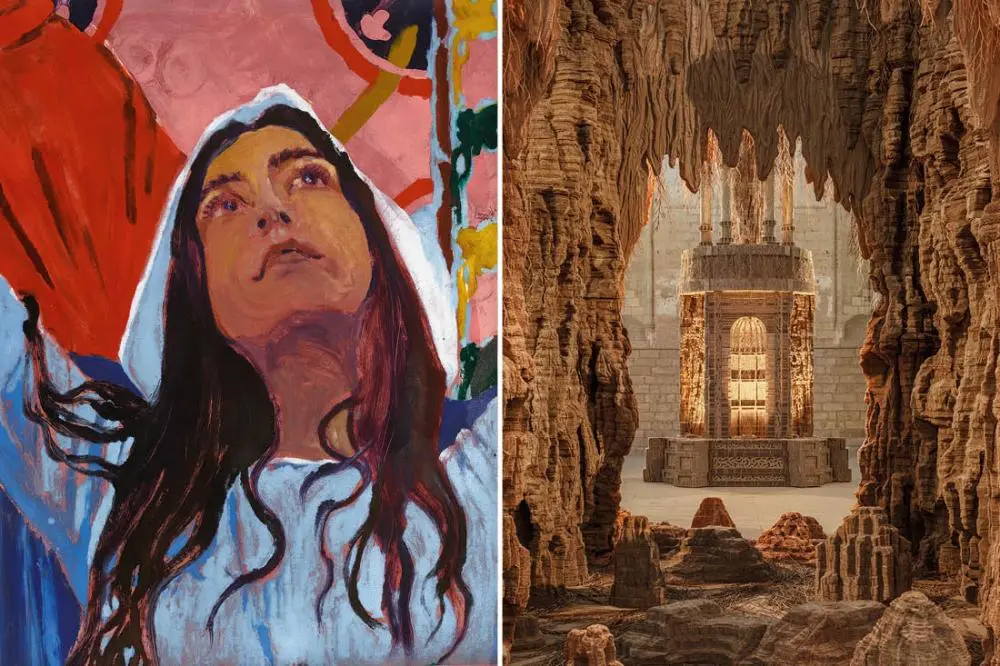
Until March 15, you're invited to explore the fascinating worlds of Eva Jospin and Claire Tabouret, presented in two Grand Palais galleries linked by the same entrance.
See content : A treasure of the Sun King soon to be displayed under the glass roof of the Grand Palais: book your tickets now!

Manufacture de la Savonnerie d’après Charles Le Brun (1619-1690), Tête d’Apollon, détail du 6e tapis de la Grande Galerie du Louvre, laine et lin, 8,82 x 5,94. Paris, Mobilier national
Article -
Seven days only, some thirty carpets on display, a royal setting resurrected: enter the legend of the Sun King, under the majestic glass roof of the Grand Palais. Ticketing is now open!
See content : Last weeks to discover Niki de Saint Phalle, Jean Tinguely and Pontus Hulten

Jean Tinguely, L’Enfer, un petit début, 1984, métal, objets et matériaux divers, moteurs électriques, 370 × 920 × 700 cm, Centre Pompidou, Musée national d’art moderne, Paris.
Article -
An artistic, playful and historic interlude before the holidays! You still have until January 4, 2026 to discover the adventure of the trio Saint Phalle, Tinguely, Hulten. Between the Swiss sculptor, the Franco-American sculptor and the Swedish curator...